Guide
How to install a solar 4G camera
Installing a solar 4G camera takes under an hour when the SIM, the signal and the sun are checked first. This is the order installers follow, so the camera comes online on the first try and stays online.
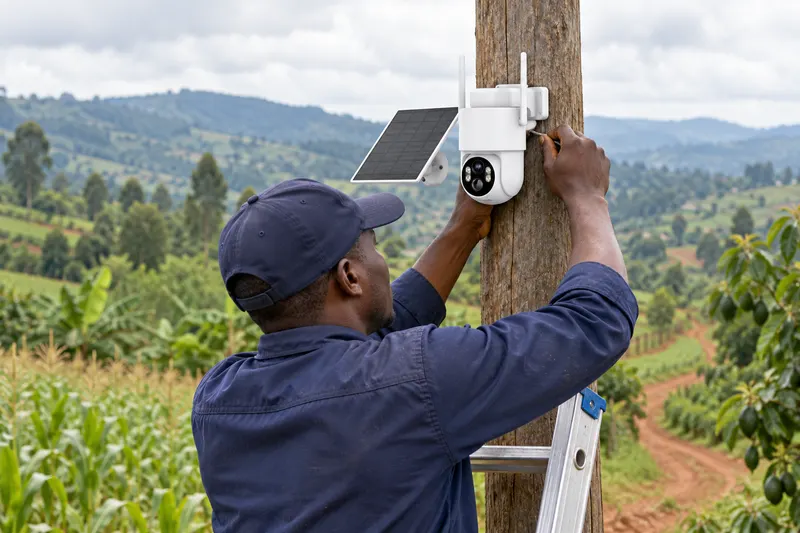
Before you go up the ladder
- Test the SIM in a phone.Remove the PIN, load a data bundle and open a web page with Wi-Fi off. Most cameras that never connect have a SIM problem, not a camera problem. The SIM card guide covers bands and data.
- Check 4G at the mounting point.Stand where the camera will go with a phone on the same network. You want 4G, not 3G or E. Height usually improves the signal.
- Charge the battery.Leave the camera and panel in the sun until the battery shows full in the app, so it starts with a reserve.
- Insert the SIM and a microSD card.Format the card in the app after pairing so recordings start cleanly.
- Pair it on the ground.Scan the QR code in the Tuya Smart or Smart Life app and confirm live view works before you mount anything. Fixing a pairing problem at the top of a pole is slow.
Choosing the spot
Decide what the camera must prove after an incident: who came through the gate, which way they went, or whether the animals were all in the pen at night. Then pick a spot that sees that clearly, rather than one that sees everything a little.
- Height: 3 to 4 m. Higher sees more ground but makes faces smaller; at a gate, lower is better for identification.
- Distance to the target: keep a gate or door within about 8 to 10 m for faces and number plates, and within the night-light range of the model.
- Backlight: avoid pointing straight into sunrise or sunset over the target, which turns people into silhouettes.
- Night reflection: keep eaves, walls and leaves out of the bottom of the picture; infrared light bounces back off them and blinds the camera.
- Panning cameras: mount the PTZ or dual-lens models where a 270° turn covers the yard without the pole blocking the view.
Fitting the solar panel
The panel decides whether the camera is still online in the rainy season, so it deserves as much care as the camera. Models with a separate panel let you put the panel on the sunniest part of the pole or roof while the camera sits in shade.
- Direction: Nigeria and Ghana lie north of the equator, so face the panel roughly south. Most of Kenya lies just south of it, so face roughly north. Near the equator the sun is high all year, so shade matters more than direction.
- Tilt: 10 to 20 degrees from flat, so rain runs off and carries dust with it. A completely flat panel collects dirt and water.
- Shade: no roof edge, branch or pole should cross the panel between mid-morning and mid-afternoon. Partial shade cuts output far more than its size suggests.
- Cable: leave a drip loop so rain runs off the cable before the connector, and fix the cable so wind cannot work the plug loose.
Not sure the panel is big enough? The panel and battery sizing guide works through the numbers for 3 W and 5 W panels.
Fixing against theft and weather
- Use the security screws supplied for the bracket, and a pole clamp or wall plugs suited to the surface.
- Run the panel cable inside the pole or along the wall, not hanging free where it can be cut.
- Point a second camera at the first on sites with a history of theft; a camera that records its own theft is less tempting.
- Turn on cloud backup for the most important camera, so the last clip survives if the SD card goes with the unit.
- On tall steel poles in open country, ask your installer about earthing; lightning is a common cause of failure on exposed poles.
Settings for the first week
- Set detection zones.Draw them around the gate, door or pen; leave out roads and trees.
- Choose human detection where available.It cuts the alerts from animals and moving shadows.
- Pick the night mode.Infrared is invisible; white LEDs give colour pictures and act as a deterrent.
- Watch the battery at 5 pm.If it is not near full by late afternoon after a sunny day, the panel is shaded or too small.
- Check data use after seven daysand adjust clip length or live viewing before the bundle runs out.
For layouts of whole farms, see the farm security guide and the livestock theft guide. To choose a camera, compare the six solar 4G camera models. Back to all guides or solar 4G cameras.
Installation questions
How high should a solar 4G camera be mounted?
About 3 to 4 metres for most farm uses. That is high enough to be out of easy reach and to see over animals and vehicles, and low enough that a face or number plate is still readable at the gate.
Which way should the solar panel face in Kenya, Nigeria or Ghana?
Nigeria and Ghana are north of the equator, so face the panel roughly south. Most of Kenya is just south of the equator, so face it roughly north. Near the equator the direction matters less than avoiding shade, so give it a 10 to 20 degree tilt so rain washes off the dust.
Do I need an electrician to install it?
No mains wiring is involved. You need a ladder, a drill, the bracket screws and a phone with the app. Installers usually fit one camera in under an hour once the SIM has been tested.
How do I stop the camera being stolen?
Mount it high on a pole or wall, use the security screws, run the panel cable inside the pole or along the wall, and point another camera at the first one where you can. Theft alerts and the last recording on the cloud help even if the unit is taken.